Is Church Integration for Mission Just a Buzz Phrase?
“No!” say two Adventist regions as they take steps to integrate their IT departments.
March 17, 2026 | Bangkok, Thailand | Marcos Paseggi, Adventist Review
“In a world that is disintegrating, God calls His church to move in the opposite direction,” General Conference president Erton Köhler recently told a group of about 400 Seventh-day Adventist leaders attending a regional summit in Bangkok, Thailand. It was the last iteration in a whirlwind tour that has taken Köhler to share that message across church regions far and wide.
According to Köhler, integration is not an administrative strategy but a spiritual necessity for the twenty-first-century Adventist Church. “It means everyone moving in the same direction with shared purpose and common commitment,” he emphasized. The benefit? “United we are stronger. We go further. We arrive faster,” Köhler said. “And we open the door for the Holy Spirit to work among us.”
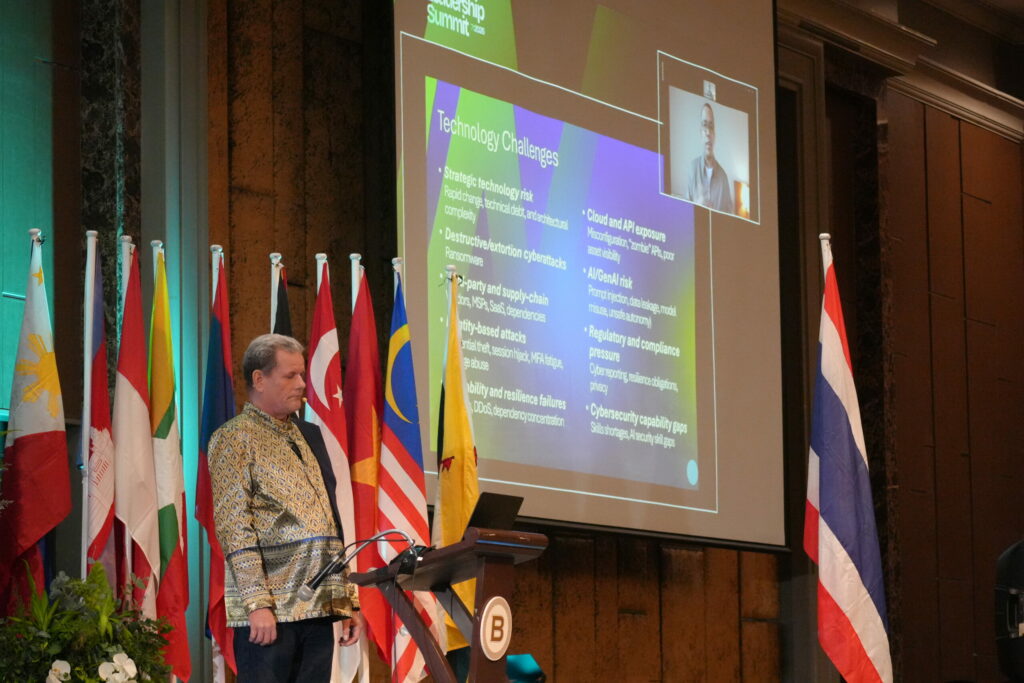
Ben Thomas, South Pacific Division IT director (left), listens to Ryan Micua, Southern Asia-Pacific Division IT director (on screen), in a joint presentation in Bangkok, Thailand, March 4. [Photo: Marcos Paseggi, Adventist Review]
While optimistic definitions from the Adventist leader might at times seem like little more than aspirational thinking, the IT departments of two world church divisions are taking definite steps to integrate their operations and collaborate in a way that may increase efficiency while decreasing costs across the board. During the recent Southern Asia-Pacific (SSD) Leadership Summit in Bangkok, Thailand, IT directors from the SSD and the South Pacific Division (SPD) shared some of the steps they are taking to streamline and synergize their operations.
On March 5 Ben Thomas from the SPD and Ryan Micua from the SSD shared some of the concrete steps they are taking to unify their technology capabilities into a single service organization. Their presentation addressed issues such as joint governance, a cost-recovery operating model, transparent usage-based pricing, and multicountry staffing that combines mature operational capability and access to specialist talent. They also discussed the initiative connection to the church’s broader digital mission direction, highlighting how governance and service design can preserve ecclesiastical accountability and reduce risk while expanding digital ministry reach.
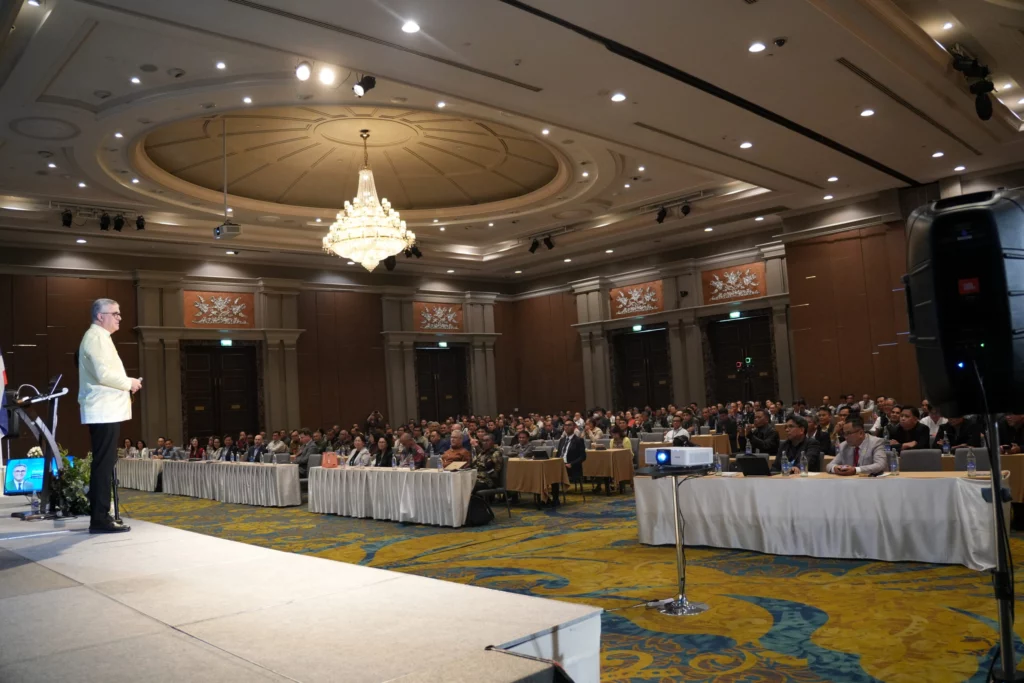
Erton Köhler, president of the General Conference, discusses the need of “moving in the same direction with shared purpose and common commitment,” during the SSD Leadership Summit in Bangkok, Thailand, March 4. [Photo: Marcos Paseggi, Adventist Review]
In our efforts to reach people groups across world church regions, technology can certainly make a difference, emphasized Thomas at the beginning of his presentation. To that end, a key question, he said, is “How can we use technology not just as a tool in administration but rather as a tool that can enable us to do mission directly?”
Micua, who presented remotely after being stranded in a hotel in Dubai because of the current Middle East conflict, agreed. “The church is not into the business of technology; the church is into the business of saving souls,” he reminded regional leaders. “Technology is not the mission, but it empowers and carries the mission. So our task as leaders is not to run IT; our task is to ensure that technology is designed . . . and funded to serve mission well.”
For that purpose, Micua appealed to “treat technology as a mission capability” of which leaders are stewards. The goal is that “technology consistently supports mission,” he emphasized.
What the New Model Entails
This philosophical backdrop naturally leads to some key questions, Micua said. “If technology is essential to mission, what should we expect from our technology teams?” he asked. It is a question that technology leaders should strive to answer, and that has led the SPD and the SSD to devise ways of combining efforts so as to avoid duplication and increase efficiency.
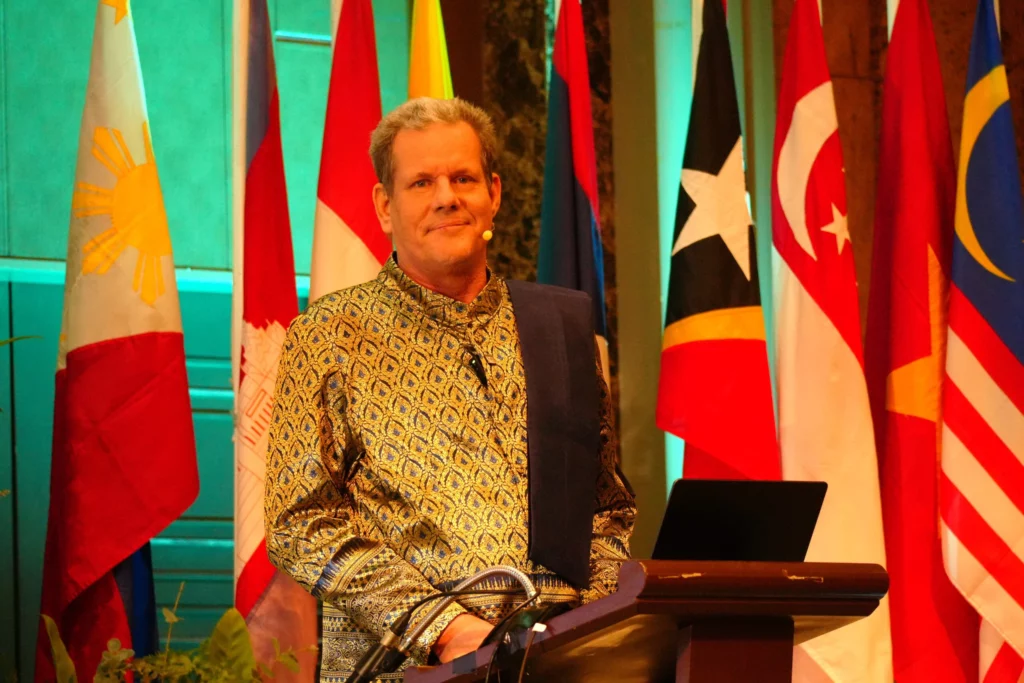
During his presentation at the SSD Leadership Summit in Bangkok, Thailand, Ben Thomas, South Pacific Division IT director, said a key question is how to use technology as a tool for mission. [Photo: Marcos Paseggi, Adventist Review]
As this is a multicountry initiative, it’s possible to combine operational capability with expert talent as needed, no matter where it’s coming from, Thomas explained. At the same time, he shared what the initiative is not. “The call is not for centralization for its own sake; the call is to get a consistent, resilient, and reliable service model that strengthens our mission and reduces our shared risk.”
How It Would Look
As part of a unified IT service, IT leaders in both divisions are working to establish a single, unified IT shared-services organization serving both divisions with GC support, IT leaders reported. Another goal is to operate on a strict cost-recovery basis, so fees correlate closely to the service provided, and use fair pricing tiers that work for both developed and developing regions.
Thomas explained that leaders are envisioning a service provider model that operates as a shared IT service for entities across the SSD and the SPD. “It will offer services on an opt-in basis to respect local autonomy and enable gradual uptake,” he reported. “Then the service would invoice each entity for the specific services used.”
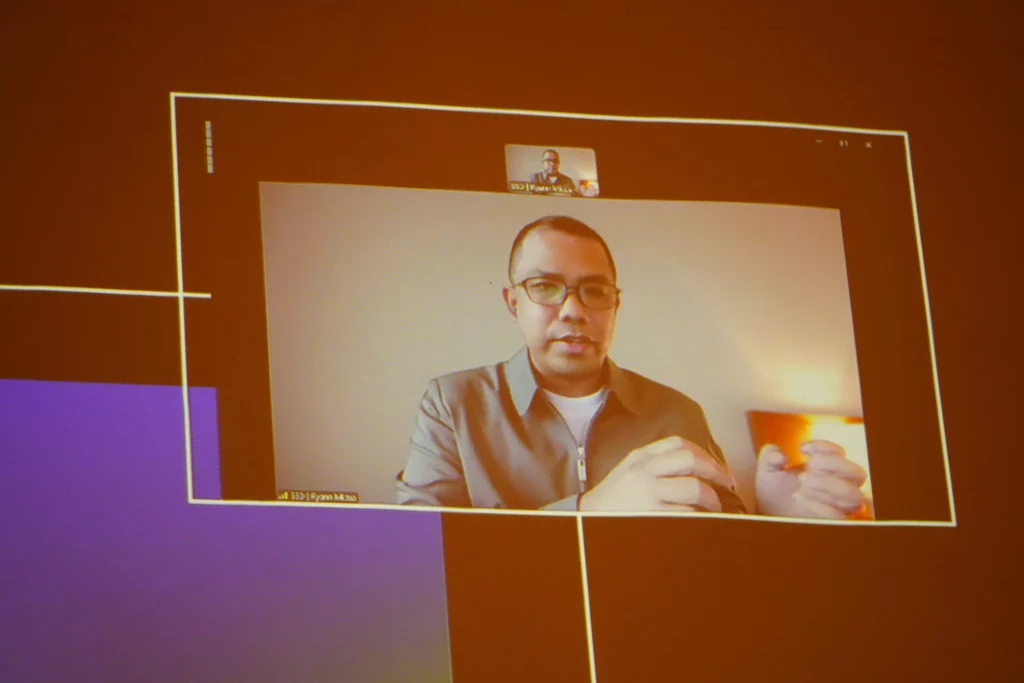
“Technology is not the mission, but it empowers and carries the mission,” said Ryan Micua, IT director in the Southern Asia-Pacific Division, during his March 4 presentation in Bangkok, Thailand, on March 4. [Photo: Marcos Paseggi, Adventist Review]
Financial Advantages
The model can also provide a sustainable financial framework, Thomas assured regional leaders, as fees would reflect only the delivery cost, and clients would pay only for the services they consume. Micua agreed. “Sustainability is one priority for this initiative, and that is definitely one of the key things to make this shared model work,” he said. “This is about stewardship, not profit.”
In that regard, Thomas mentioned the benefits of shared volume pricing. He explained that it can lead to signing master contracts, which result in lower unit pricing. “Savings are then passed on as reduced service costs or fees,” he said, “and benefits increase as more entities join.”
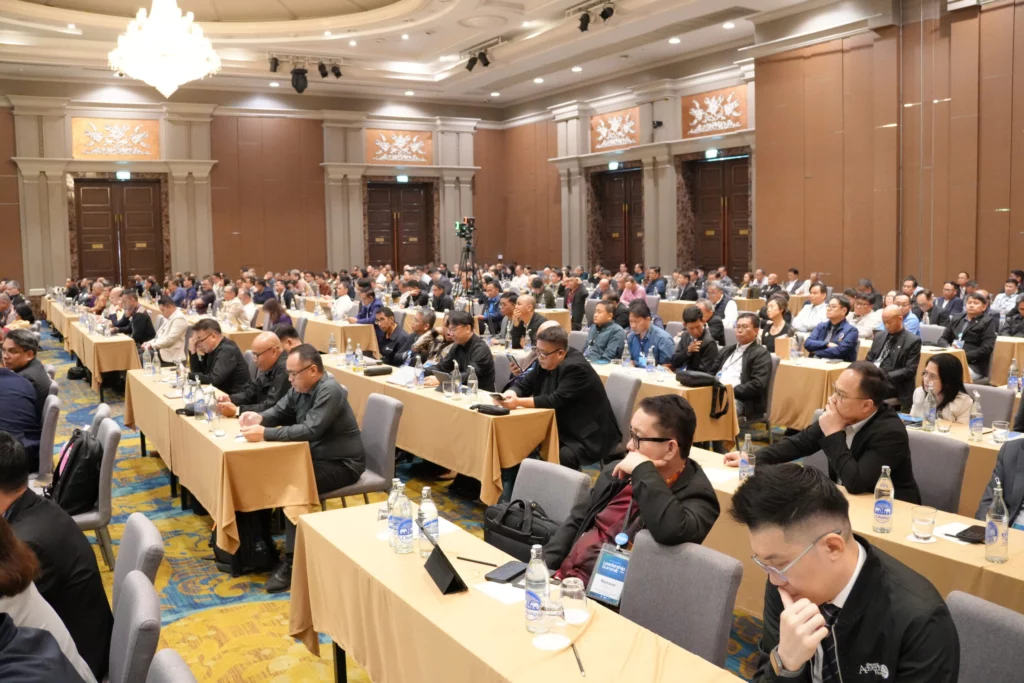
Adventist leaders from across the Southern Asia-Pacific Division listen to the presentations in Bangkok, Thailand, on March 4. [Photo: Marcos Paseggi, Adventist Review]
Next Steps
Micua explained that as concerns their IT services, the goal for the SSD and SPD is that both divisions stay aligned over time even if needs and leadership change. In that regard, Thomas explained that as part of a phased approach, they are focusing initially on the platform, including email, storage, communications, and security. In a second phase, the plan is to move to procurement and licensing, then their help desk, and finally, IT policy, guidelines, and standards.
“This approach strengthens mission outcomes by improving our consistency across all our territories,” Micua shared, “so we can build resilience, get ministry going, and fight disruption. . . . The benefit is not a stronger IT; it is a stronger, safer foundation for integrated technology for mission.”