Pentecost 2026 Boot Camp Equips Church Leaders for Evangelism and Church Planting
March 19, 2026 | Columbia, Maryland, United States | Art Brondo, North American Division
Nearly 500 pastors, church planters, and ministry leaders gathered March 11–15 at Camp Kulaqua Retreat and Conference Center in High Springs, Florida, for the Pentecost 2026 Boot Camp, five days of training designed to strengthen evangelism, discipleship, and church planting across the Seventh-day Adventist Church’s North American Division.
The event is part of the division’s broader Pentecost and Beyond initiative, a multi-year effort focused on mission, revival, and church growth.
Jose Cortes Jr., associate director for evangelism for the North American Division, shared that the boot camp builds on a series of ministry training events that began in 2016.
“This is the 11th installment of boot camps in North America,” Cortes said.
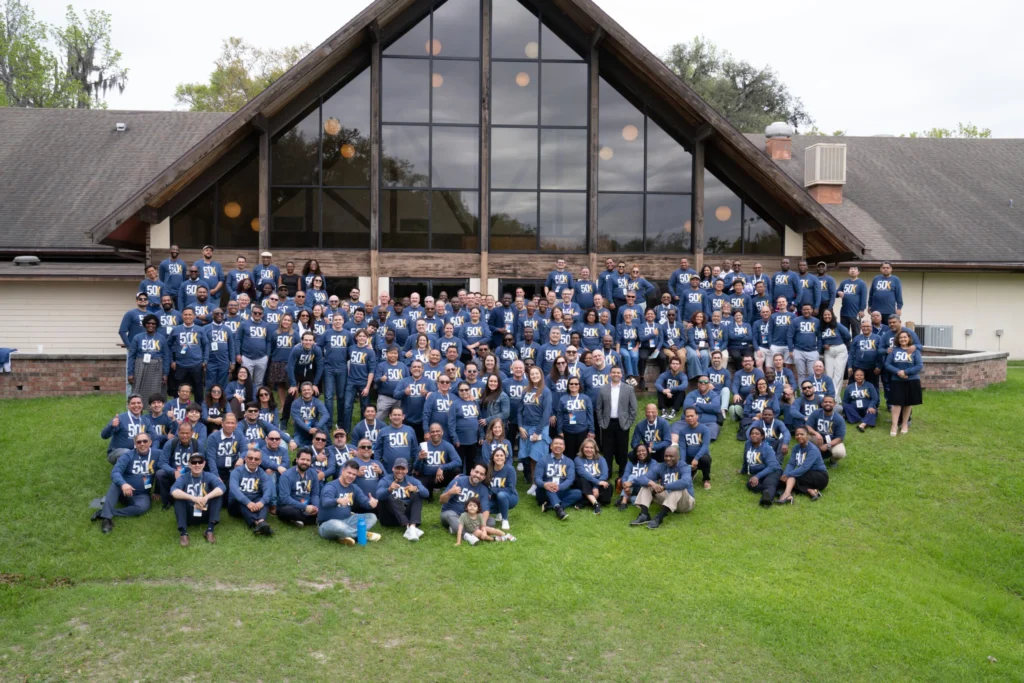
Pastors, church planters, and ministry leaders gather for a group photo with organizers from the North Pacific Union Conference during the Pentecost 2026 Boot Camp, held March 11–15 at Camp Kulaqua Retreat and Conference Center in High Springs, Florida. Dressed in matching blue shirts, participants celebrate five days of training focused on strengthening evangelism, discipleship, and church planting across the Seventh-day Adventist Church’s North American Division. [Photo: North American Division]
“In the past, we were doing five boot camps every year,” Cortes said. “We decided to combine them so people can come once and receive training in all these areas.”
Training Focused on Mission
This year, participants attended workshops and presentations on church planting, church revitalization, pastoral evangelism, volunteer lay leadership, and missional small groups.
Cortes said the goal is to help churches move beyond growth toward multiplication.
“We want to see a church in North America that not only grows but multiplies.”
He also emphasized the importance of discipleship and engagement for long-term church growth.
“The future of the church is not determined only by the number of baptisms, but by the follow-up that we do,” Cortes said.
One major initiative connected to the training is the goal of establishing 50,000 missional small groups across the North American Division over the next five years. These groups are intended to meet in homes and community spaces, creating environments where people can build relationships and explore faith.
“We don’t believe that evangelism is done in only one way,” Cortes said. “But at the end of the day, we want to see more disciples and more churches.”
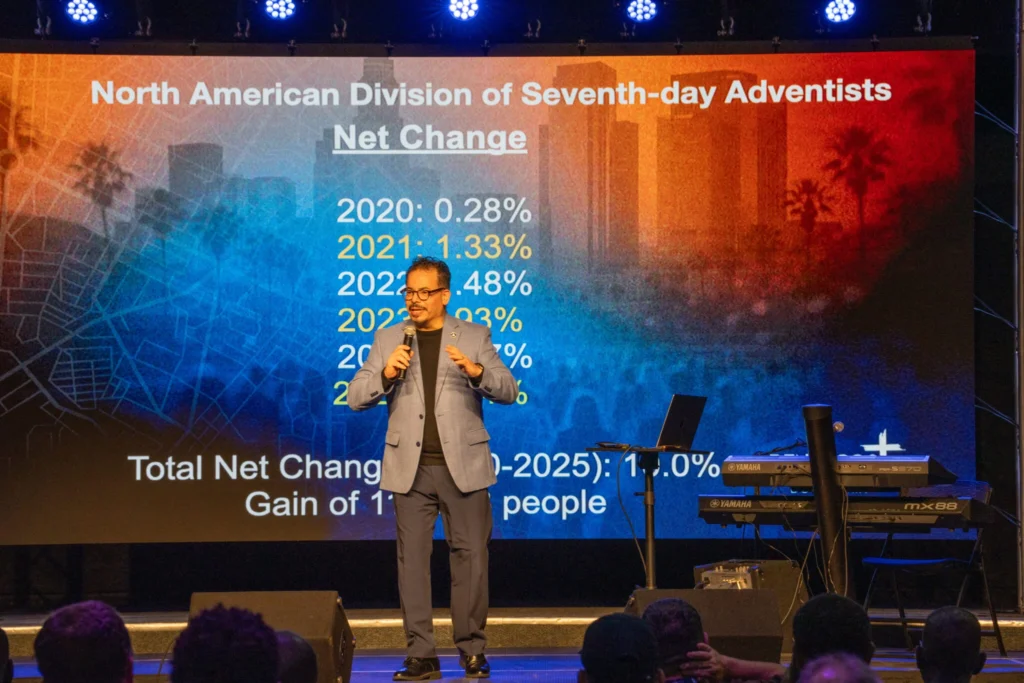
Jose Cortes Jr., associate director for evangelism for the North American Division, welcomes attendees to the boot camp and highlights the importance of discipleship and engagement for long-term church growth during one of his presentations.[Photo: North American Division]
Part of a Broader Mission Movement
Gerardo Oudri, associate director of the division’s Ministerial Association, said the boot camp supports the broader Pentecost and Beyond movement by equipping leaders to carry out the church’s gospel mission.
“Pentecost was not just about having many people baptized,” Oudri said. “It was about receiving the Holy Spirit and the church being led to fulfill its mission.”
He noted that the event encourages both spiritual renewal and practical ministry training.
“We want people to be spiritually uplifted and inspired,” Oudri said. “Not only by the presentations, but also by the interactions.”
Combining several ministry tracks into one event also gives participants a broader view of how different outreach approaches can work together, he added.
Networking and Collaboration
For many participants, the opportunity to connect with other ministry leaders is one of the most valuable aspects of the boot camp.
Michael Lewis, a presenter at the event, said conversations outside the main sessions often provide encouragement and practical insight.
“Often, what really helps people move forward in ministry is the conversations that happen off the stage,” Lewis said.
Those discussions allow pastors and leaders to share experiences, challenges, and strategies.
“Pastoral ministry can be lonely,” Lewis said. “To come to boot camp and talk with someone who understands what you’re trying to do is like air to your lungs.”
Lewis said the event has already led to collaboration among leaders, including a new project he plans to develop with another presenter to improve ministry processes.
International Participation
Although the boot camp focuses on the North American Division, it also attracts participants from other regions of the world.
This year, a delegation of nearly 40 leaders from the South Pacific Division attended the training, representing Australia, New Zealand, and Papua New Guinea.
Wayne Krause, director of Global Mission, Study Centers, Church Planting and Mission to the Cities for the South Pacific Division, said the event helps expose leaders to the broader global church.
“We want to expose our team to the wider Adventist family,” Krause said. “It helps them see how ministry is happening in other parts of the world.”
“We learn what others are doing and then ask how it could work in our context,” Krause added.
The diversity of the South Pacific Division highlights the complexity of global mission work. Papua New Guinea has experienced significant church growth in recent years, while countries such as Australia and New Zealand face increasing secularism.
“About 20 years ago, roughly a third of Australians identified as Christian,” Krause said. “Today, Christianity is clearly a minority.”
Despite those differences, Krause said gatherings like the boot camp strengthen partnerships across the global church.
“Events like this remind people that they are not alone,” he said.
From Ideas to Action
Organizers say the ultimate goal of the boot camp is to help ministry leaders turn ideas into action in their communities.
“In leadership, you need vision, and you need strategy,” Oudri said. “But eventually, you need action.”
Participants are encouraged to return to their churches with practical strategies for evangelism, discipleship, and church planting.
Lewis said the training often re-energizes pastors facing ministry challenges.
“Boot camp can help a person push through those challenges,” he said.
For Cortes, the event reflects a larger vision for the future of the church.
“We want to see a multiplying church in North America,” he said. “A church that disciples people and plants new congregations.”