
Should the Adventist Church Look to the Past or the Future?
October 11, 2026 | Silver Spring, Maryland, United States | Marcos Paseggi, Adventist Review
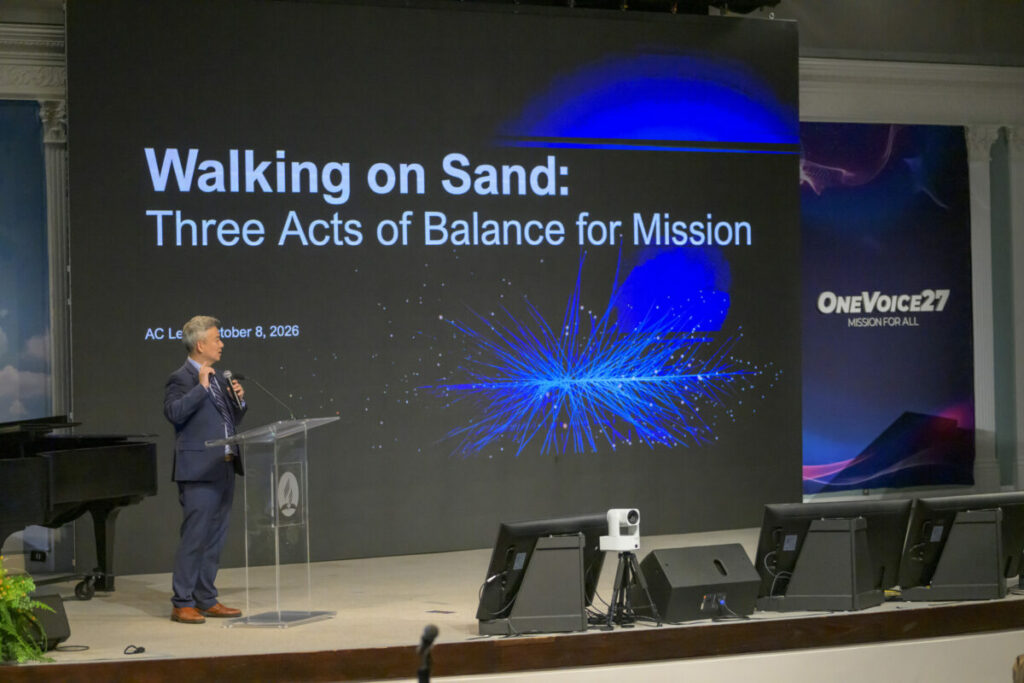
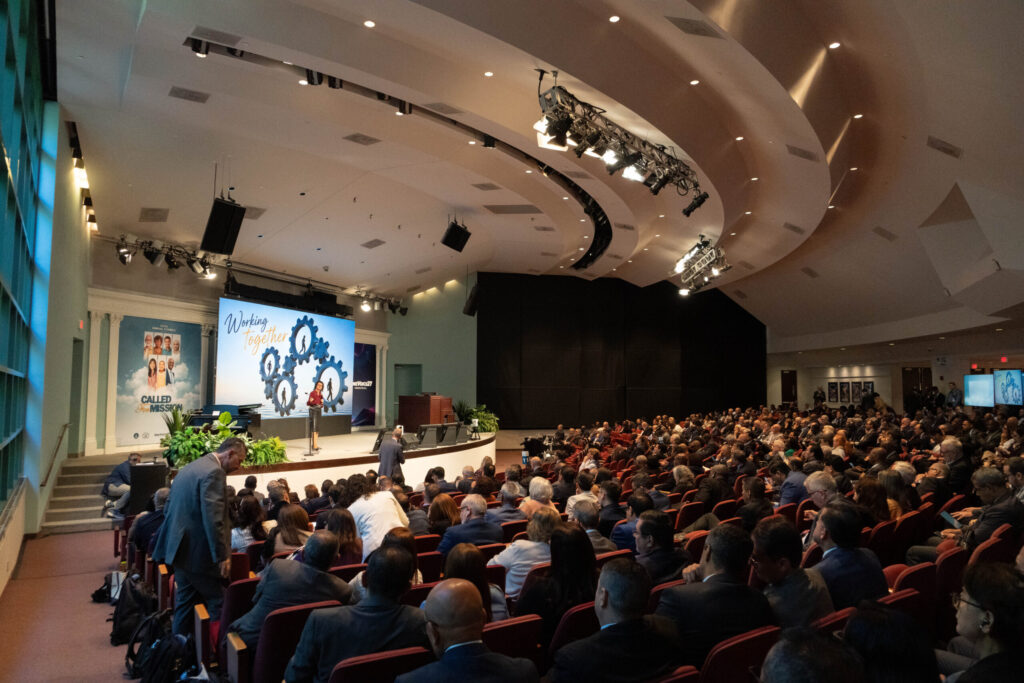
“We, as leaders, must make a calculated move to be balanced in the midst of tension,” Adventist Review editor Justin Kim told Seventh-day Adventist leaders on the first full day of meetings of the General Conference Executive Committee (GC EXCOM), October 8. During his brief message Kim reviewed longstanding tensions in church life and leadership and suggested a way forward, especially in regard to the way media is used to support the mission of the church.
Tensions Are Unavoidable
Tensions in leadership, Kim suggested, are unavoidable. “As planets must not be too close to the sun nor too far away to sustain life, academics must walk between simple and complex; treasurers must equalize between spending and saving; [and] executive secretaries must fight for the collective or the individual,” he said. At the same time, “presidents must balance exercising power or withholding power, [and] communicators must balance efficacy with efficiency.”
In Adventist theology we see this all the time, Kim explained. “Justification and sanctification, grace and works,” he said. “Principle and compassion, people and ideas, humanity and divinity, the First Coming and the Second Coming, mercy and justice.”
Over the next few minutes Kim delved into three sources of tension between media and mission.
Past or Future?
One source is people nostalgic for history. “When you look into the past, these are the ideals that worked, and whenever someone presents something in the future, you don’t like it, because you don’t know if it’s going to work. These are memory-leaning people,” he said.
Others, Kim explained, look to the future and the uncertainty, the unknown, and the hope that is much brighter than the past. They say, “We don’t know how it’s going to look, but the future looks much better than right now. These are dream-leaning people,” Kim said.
Kim then explained that how every person is right now will create tension in the church. “This has nothing to do with age . . . [or] theology—conservative or liberal,” he said. “It’s tension of time frame.” He added, “Some people’s temperaments are this way, some people’s culture is this way, and some people’s neurological function is this way. Since we all have different experiences, this will impact how you receive media and technology, your view of the institution, and your view of leadership.”
Kim then suggested to move past those two extremes of memory-leaning and dream-leaning to become mission-leaning. “We must be rooted in the present, we must look back to the past to how we started, and that gives us momentum to the future,” he said. “Being mission-oriented encapsulates present, past, and future.”
Institution or Movement?
There’s also a tension between the church as an institution and a movement, Kim acknowledged. The former focuses on policies, procedures, and systems. “It is interested in long-term survival and is continuity-based,” he said. “And there’s always a danger of an institution becoming a corporate profit-oriented organization.”
The latter is risky, because “it’s forward-looking. It’s decentralized and influence-based,” he said. “It has a short life cycle, and it’s based on charisma or a personality. If this one individual dies, the entire movement evaporates,” he illustrated.
But rather than being a movement or an institution, the Adventist Church should strive to be mission-inclusive, Kim suggested. “It involves policy and passion, procedures and conviction, systems and vision,” he shared.
Above all, Kim emphasized, it “must be person-centric—and sacrifice-oriented—for a church to move forward.”
Perception or Performance?
A third tension in the church, Kim mentioned, is between perception and performance. Perception focuses on public relations, brand and media, and community service, to illustrate a few. People who are perception-oriented “are worried how the church looks on the outside,” Kim said. “They focus on the mingling, the ministering, the winning of confidence, and they are thinking of the church in the long term.”
Those focused on performance, however, focus on numbers, results, and output. “These are people focused on baptisms, reaping events . . . and appeals,” Kim said.
For the church to move forward, Kim suggested, those two sides must be in constant dialogue. “It’s a dialogical view, where you are not looking at ‘either-or,’ but at ‘and.’ ” Kim was happy to report that in his view, it’s what the Adventist Church is already doing with the leaders’ renewed focus on integration. Interconnection, interdependence, is the way to go, he said.
Nimble Leaders
For mission in media to be effective, all these elements must be combined, Kim repeated. “We must look at past ideals, the present realities, and the future hope,” he said. “We must have a mission-inclusive perspective that has institutional integrity and the momentum of the vision of a movement.”
Finally, Kim suggested: “Different stages and different regions of the church require leaders to be nimble,” able to walk on the narrow strip in the middle, he emphasized. “It’s much more profound than finding balance. It requires the wise, careful, and sensitive following of Jesus.”
Related news
 From the World Church
Rick Remmers Elected General Conference General Vice President
Three decades of pastoral and administrative leadership prepare Remmers for global role.
From the World Church
Rick Remmers Elected General Conference General Vice President
Three decades of pastoral and administrative leadership prepare Remmers for global role.
 From the World Church
Church President Makes Impassioned Plea to Move Forward Together
Erton Köhler appeals to Seventh-day Adventist leaders to make mission a priority.
From the World Church
Church President Makes Impassioned Plea to Move Forward Together
Erton Köhler appeals to Seventh-day Adventist leaders to make mission a priority.
 From the World Church
Adventist Church Introduces New Children’s Books Designed for Outreach
New Alive in Jesus Mission Edition books share Bible stories with families unfamiliar with Christianity.
From the World Church
Adventist Church Introduces New Children’s Books Designed for Outreach
New Alive in Jesus Mission Edition books share Bible stories with families unfamiliar with Christianity.