
The Quiet Deception of Pride

Identity, motivation, and the subtle erosion of God-given worth.
April 29, 2026 | Silver Spring, Maryland, United States | Jeremy Hall for Adventist Review
Pride and the Question of Value
Pride can be a covert foe. It often sneaks up on us in ways we may not tangibly recognize.
One statement in this week’s lesson stood out to me in particular: “Pride emerges from the desire to show that our lives have value.” As an educational administrator and a clinical therapist, I find this observation both fascinating and troubling. If I desire to show that my life has value, am I not already starting from a deficit position? If I feel compelled to prove my value, I must be operating under the assumption that it does not intrinsically exist.
Scripture presents a very different starting point:
“For You formed my inward parts;
You covered me in my mother’s womb. . . .
I am fearfully and wonderfully made”
(Ps. 139:13, 14).
If God knit us together before we were capable of achievement or failure, then our value was established prior to anything we could ever do right—or wrong. Sin, however, separates us from God and clouds our ability to understand the value He established when He created us. Adam and Eve sinned and then hid. God sought them out. Why? Because He had and still has a solution for sin, and deeply values the sinner! If we were not valuable after we sinned, then why would God have sought out Adam and Eve with the remedy for their mistakes? He is still seeking.
“For the Son of Man has come to seek and to save that which was lost”(Luke 19:10).
What does this have to do with pride? Let’s look a little deeper.
Guilt, Self-devaluation, and False Humility
I have spoken with many individuals who are weighed down by guilt over past mistakes and by deeply internalized perceptions of being “less than.” Over time this can evolve into self-punishment and chronic self-deprecation. They lower expectations for themselves and sometimes accept unhealthy standards in friendships or marriages because they do not believe they deserve better. Sometimes they fall into a pattern of doing good works because they perceive that their good works somehow earn back their value as a person. Sometimes we take pride in the perceived “recovery” of our value from a disparaged state, and our Christian experience becomes akin to a business exchange. Worse still, we feel better hearing about the woes and mistakes of others, because we are scrambling for a prideful comparative analysis that makes us feel somehow better because “at least we haven’t done something as bad as our neighbor has.”
Yet Scripture speaks clearly that there isn’t anything we can do to “recover” ourselves except to confess, repent, and accept Christ’s righteousness. The only way we can escape condemnation is if we are in Christ:
“There is therefore now no condemnation to those who are in Christ Jesus” (Rom. 8:1).
Our worth, our existence itself, cannot be increased by good behavior or diminished by failure. Because we are beings created by God’s hand, our value is intrinsic. Nothing we do can add to it, and nothing we do can take it away. Prideful striving, then, is not evidence of strength, but a quiet contradiction of the value God has already assigned to us.
Motivation, Accomplishment, and the Trap of Recognition
When we attempt to define ourselves by achievement or recognition, we fall into what might be called the accomplishment trap; that is, valuing what success does for us rather than what God intends to do through us. This is ultimately a question of motivation: why we do what we do, say what we say, and seek what we seek.
Western culture reinforces this trap with language that encourages self-focused pride: “Take pride in what you do” or “You should be proud of yourself.” While often meant as affirmation, such language can slowly tether our identity to praise. Over time, recognition feels life-giving, while its absence feels life-sapping.
Scripture offers a corrective:
“Whatever you do, do it heartily, as to the Lord and not to men”(Col. 3:23).
When recognition becomes the motivation, comparison inevitably follows, and comparison quietly breeds dissatisfaction, jealousy, and wounded pride.
I recently listened to an interview in which a famous actor was speaking with a reporter. The actor stated that 99.9 percent of the time, being famous and recognizable was good. It felt good to hear people say they loved him, recognized him, and spoke kindly about him. On one occasion he hired a makeup artist to make him look unlike himself. He spent the day walking through a famous market in Los Angeles, and no one recognized him the entire time. He stated that he didn’t like that experience and preferred being famous and recognizable. Essentially his identity was correlated to an external evaluation rather than an internal one.
As God’s people we must be conscientious about what is shaping our motivation. Are we doing good works because we seek the recognition of others, particularly those within our faith community, or are we doing good works as the natural consequence of a genuine personal relationship with Jesus? The danger, when motivation is rooted in the wrong place, is the all-consuming trap of comparative analysis. We begin to spend too much time comparing our accomplishments and the accompanying accolades with those around us.
More sinister still, we may begin to feel jealous of the status or positions of others and, like Lucifer, we become dissatisfied. We begin to ask such questions as “Why did that person get elected to that office?” or “I think I’m just as qualified.” Perhaps a friend tells us they were surprised we didn’t get the position. Or we may feel wounded pride because we weren’t invited to a high-level, confidential planning meeting when others, whom we perceive as “less qualified,” were. Conversely, if we are elected or asked to serve on a special committee, we may feel a dangerous level of pride in our perceived importance or wisdom, believing we are sought after for what we bring rather than for what God intends to do through us in whatever role we hold.
Why Pride Is So Spiritually Dangerous
At the midpoint of Wednesday’s lesson we encounter one of the most sobering inspired statements of the week. Ellen White writes:
“There is nothing so offensive to God or so dangerous to the human soul as pride and self-sufficiency.”[*]
I don’t believe God hates this sin more because it is the greatest assault against Him personally, or merely because it was the sin that cast Lucifer from heaven. I believe God hates it most because it carries the greatest risk of eternal loss for His children. Why? Because pride is a false vision, a kind of virtual reality in 8K that blinds us to the authentic picture of who we are and to a clear recognition of who God is. It is the fatal flaw, and I believe it lies at the root of every sin. It is identity overextension, and often the risk is unseen while the consequences are bitter.
I am thankful that this quarterly has highlighted such an important topic. May we spend time with God each day so that our understanding of who we are is never less than He intends and certainly never more than we were created to be.
“God resists the proud, but gives grace to the humble” (James 4:6).
[*] Ellen G. White, Christ’s Object Lessons (Washington, D.C.: Review and Herald Pub. Assn., 1900, 1941), p. 154.
Jeremy Hall serves as director of the Education Department for the Michigan Conference. He has served in various roles in Adventist education during the past 25 years, including boys’ dean and campus chaplain/religion teacher, as well as principal and superintendent. He also holds licensure as a master’s-level psychologist.
Related news
 From the World Church
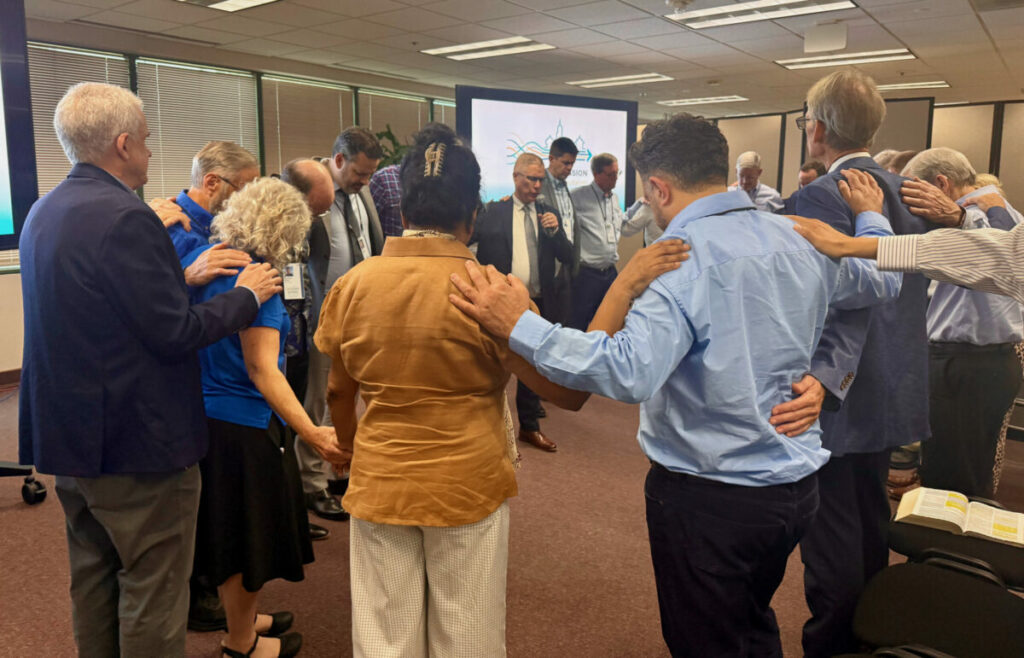
GC and Supporting Ministries Gather for First “Aligned for Mission” Consultation
Three-day meeting focuses on greater cooperation in reaching people groups.
From the World Church
GC and Supporting Ministries Gather for First “Aligned for Mission” Consultation
Three-day meeting focuses on greater cooperation in reaching people groups.
 From the World Church
Church Construction Can Have a Spiritual Purpose, Adventist Leader Says
Union president provides the biblical rationale for building places of worship.
From the World Church
Church Construction Can Have a Spiritual Purpose, Adventist Leader Says
Union president provides the biblical rationale for building places of worship.
 From the Headquarters
World Pathfinder Day
The following message is addressed to the Seventh-day Adventist Church in Inter-America by Abner De los Santos, president of the Inter-American Division. — IAD…
From the Headquarters
World Pathfinder Day
The following message is addressed to the Seventh-day Adventist Church in Inter-America by Abner De los Santos, president of the Inter-American Division. — IAD…